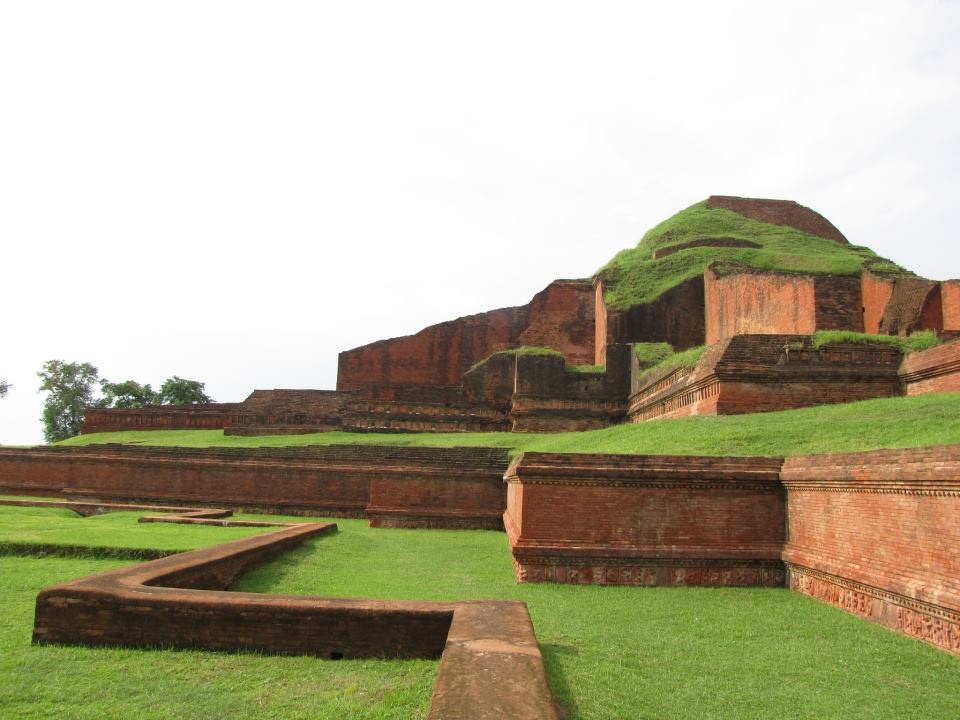
Nalanda was a renowned Mahavihara (large Buddhist monastery) and the world's first residential university, active from the 5th century CE to the 12th century CE under the patronage of the Gupta and Pala kings. At its peak, it housed over 10,000 students and 2,000 teachers, attracting scholars from China, Korea, Tibet, and Central Asia.
1. The Architecture of Nalanda
The excavated ruins of this UNESCO World Heritage Site reveal a highly planned, symmetric layout built entirely of red bricks. The university featured:
- Monastic Cells (Viharas): Residential quarters for students, equipped with stone beds, study niches, and personal water wells.
- Classrooms & Lecture Halls: Covered and open-air podiums where philosophy, grammar, logic, math, and medicine were discussed.
- Great Stupa of Sariputra: A majestic, tiered stupa dedicated to Buddha's chief disciple, decorated with beautiful stucco carvings.
2. The Mountain of Truth: Dharma Gunj Library
Nalanda's library, named Dharma Gunj (Mountain of Truth), was a massive complex consisting of three nine-story buildings: Ratnasagara, Ratnodadhi, and Ratnaranjaka. It housed millions of manuscripts covering ancient sciences, philosophy, and spiritual texts. Historical records show that when the library was set on fire during the invasions of Bakhtiyar Khilji in 1193 CE, the massive collection of manuscripts burned continuously for three months, marking a tragic loss for global knowledge.
3. The Travelogues of Hiuen Tsang
The Chinese traveler Hiuen Tsang spent several years at Nalanda as a student and later as a teacher. His detailed diaries provide a vivid description of the academic rigor, daily rules, and layout of the university. Today, a memorial hall built in his honor near the ruins exhibits his relics and records.
4. Travel Tips for Visitors
Nalanda is located 90 km from Patna. Visitors should hire a registered ASI guide to understand the layout of the ruins. The Nalanda Archaeological Museum, situated directly opposite the entrance, exhibits rare bronze statues, seals, and pottery excavated from the site.